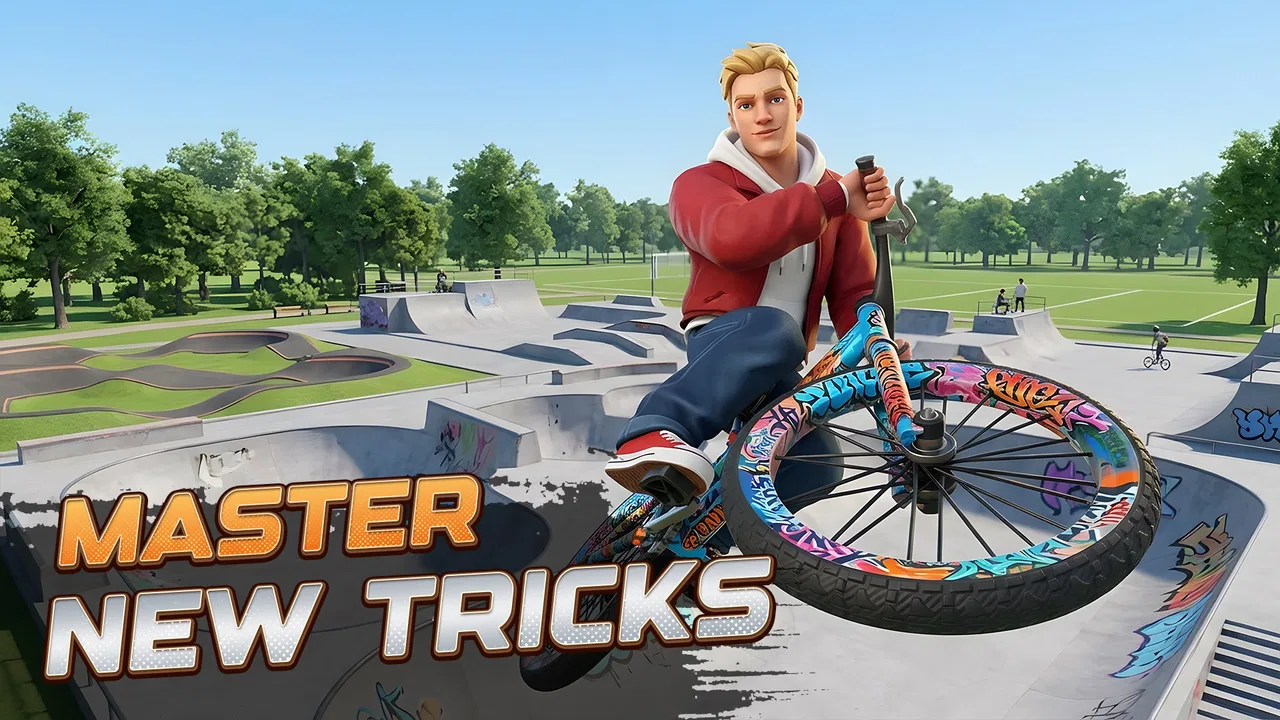
BMX Playground
- 4.5
- Rating
- 1.00M
- Installs
- Free
- Price
 Analysis by App-foxy
I approached BMX Playground as a short-session sports game rather than a serious cycling simulator, and that distinction matters. Its appeal is immediate: you ride a BMX, look for room to move, and turn ordinary space into a place for flips and stunt attempts. The free-to-play format makes it easy to try, while the Everyone age rating keeps the tone accessible for a broad audience. After spending time with it, I see it as a relaxed playground for experimentation, not a substitute for a structured racing game or a technically demanding bike simulation.
The game comes from Lemon Global and sits in the sports category. It has reached over a million installs and holds a 4.4 average from around one and a half thousand ratings, which suggests that its simple stunt-focused idea has found an audience. I would still judge it on the kind of session it offers rather than popularity alone. If you want a game that lets you practise timing, try amusing combinations, and return for a few minutes without committing to a long event, it is an appealing choice.
What to decide before downloading
Before downloading, I’d decide whether I enjoy setting my own goals or need a game to supply them. BMX Playground is free to try, but its lasting appeal depends more on whether repeating and refining stunts feels satisfying than on the first few exciting attempts. I’d also think about who will use the device and agree on purchase expectations in advance; that makes it easier to judge the riding on its own terms.
You May Also Like

 Blood Strike: 2.5 Anniversary
Blood Strike’s Loadouts Turn Every Drop Into a Tactical Gamble
A close look at Blood Strike’s custom loadouts: how fast access to signature weapons reshapes its battle royale rhythm, rewards preparation, and narrows the gap between fights.

 Pandora - Music & Podcasts
Pandora’s Music Is Easy to Start, but Harder to Recover
Pandora’s strength is its low-effort path from a seed to a station. Its weak spot is how much confidence it asks you to place in connection, setup, and quiet recovery.

 8 Ball Pool
 Is Built on Rivalries, Rematches, and Routine
A close look at the rivalries, rematches, shared routines, and unanswered safety questions that turn a quick pool match into a persistent mobile community.

 Samsung Music
’s Quiet Strength Is Playing What You Already Own
Its reach comes less from spectacle than from dependable access to a personal library. That simplicity is both the app’s strongest retention engine and its ceiling.

 AccuWeather: Weather Radar
AccuWeather Review: A Quick, Clear Forecast for Everyday Decisions
For everyday plans, the best forecast is the one you can understand quickly. AccuWeather makes rain timing, radar, and local conditions easy to act on, with a few trade-offs.

 Hill Climb Racing
Why Hill Climb Racing Still Turns Crashes Into One More Run
A tiny car, a bumpy hill and one more upgrade: Hill Climb Racing keeps resurfacing because its simple chaos makes every near-miss feel personal.
More From Our News Desk
View All News


Choose the kind of sports game you actually want
The first question is whether you prefer freedom or structure. BMX Playground is built around the pleasure of moving through an open BMX setting and attempting tricks at your own pace. That makes it different from a conventional sports title where the main goal is winning a race, completing a fixed match, or following a career ladder. I enjoyed the lack of pressure, especially when I wanted to test an idea instead of chasing a result.
That freedom also means the game may feel light if you need constant objectives. Players who enjoy leagues, opponents, unlockable campaigns, or tightly designed challenges may find a dedicated racing game more satisfying. Here, the attraction is the riding itself. You create your own small goals: clear a jump, land a flip, approach a feature from a new angle, or simply see how long you can keep a run going.
Consider how you plan to play
This is best suited to brief, repeatable sessions. I can imagine opening it while waiting for an appointment, taking a few attempts at a stunt, and closing it without feeling that I abandoned a complicated story or multiplayer commitment. It also works as a casual game to share with a younger player who likes bikes and exaggerated movement but does not want a difficult simulation.
For longer sessions, your enjoyment will depend on how much you like self-directed play. The same open playground that feels liberating at first can become familiar if you need a steady stream of new situations. My advice is to treat each visit as a practice session. Pick one movement to improve, explore a different line through the space, and stop when the experimentation starts to feel repetitive.
Controls matter more than the store summary suggests
Stunt games live or die by their controls. A simple layout can make a flip feel rewarding, while imprecise input can turn every landing into guesswork. I found that the best way to approach this game is to make small, deliberate adjustments instead of treating every jump as an invitation to press everything at once. Build a reliable approach first, then add rotation or extra movement.
That is also my first practical tip: learn the timing of a clean landing before chasing the flashiest stunt. A controlled run teaches you more than a chaotic attempt that happens to look impressive. Once you understand how speed, takeoff angle, and midair input interact, the playground becomes much more interesting because you can experiment with intention rather than random button combinations.
Free does not mean completely frictionless
The game is free to download, but optional in-app purchases are listed at between three and four dollars per item. That does not automatically make the experience poor, yet it is worth deciding how you feel about spending before you start. I would begin without buying anything and see whether the basic riding loop holds my attention. If the core movement already feels enjoyable, an optional purchase can be considered on its own merits rather than as a rescue for a disappointing first impression.
This approach is particularly useful for families. Since the content rating is Everyone, the game may appear suitable for a wide range of players, but a parent should still handle purchase decisions directly. The safest habit is to establish a no-purchase expectation before handing over the device, especially because the game is designed to be easy to open and play casually.
Check the practical compatibility details
The current version is 1.09, and the minimum operating system requirement is Android 7.1. That makes the entry point fairly approachable for people using older Android hardware, although the actual feel will still depend on the phone or tablet. Stunt games benefit from responsive touch input and stable performance, so I would test it on the device you intend to use rather than assuming that an older handset will provide the same experience as a newer one.
Another useful decision point is your tolerance for repetition. BMX Playground gives you a space to revisit, so its value comes from improving your own control and inventing routes. It is not the right choice if you expect every session to deliver a new story beat or a large checklist of content. That is not a flaw in itself; it is simply the trade-off behind a playground-style design.
Where BMX Playground earns its place
To see whether BMX Playground deserves a regular spot on my device, I’d pay attention to what draws me back after the novelty of a new trick wears off. A useful test is to return with a small riding goal and notice whether the open space still invites experimentation or starts to feel familiar. That distinction helps me decide if it works as a dependable short-break game or whether a more structured sports title would suit me better.
The open setting supports experimentation
The strongest part of the game is the way it encourages me to try something without worrying about a strict race clock. In a traditional BMX event, I might focus on a score or a finish line. Here, I can use the available space as a laboratory. I can approach the same feature with a different speed, delay an input, or attempt a landing from a new direction. That makes even a failed run useful when I understand why it failed.
This is one of the less obvious strengths: the game can function as a small concentration exercise. I often get better results when I stop trying to perform a spectacular sequence and instead divide it into stages. First I line up the approach, then I manage the jump, and finally I prepare for the landing. That workflow is more rewarding than repeatedly restarting after an uncontrolled launch.
It is welcoming without demanding sports knowledge
You do not need to understand competitive BMX terminology to enjoy the basic idea. The visual language is clear: ride, jump, flip, and try again. That makes it a comfortable recommendation for someone who likes arcade sports games but does not want a rule-heavy introduction. I could also see it working well for a child and an adult taking turns, with each person setting a small stunt challenge for the other.
The Everyone rating reinforces that broad accessibility, but I would not confuse accessible presentation with automatic mastery. The game may be easy to understand, yet satisfying landings still require attention. That combination is useful: a new player can begin immediately, while a more patient player can spend time refining movement.
It turns spare time into a focused activity
A realistic everyday scenario is a short break between tasks. Instead of starting a long match that demands uninterrupted attention, I can launch the game, make several attempts at one movement, and leave with a clear sense of progress. The lack of a complicated setup is valuable on mobile, where the best game is often the one I am willing to open again tomorrow.
My second practical tip is to give each session a single theme. One visit might be about clean landings; another might focus on finding a smoother route through the playground. This prevents the open environment from feeling aimless and helps turn casual play into a personal progression system, even if you are not following a formal campaign.
The scale of the game can be a benefit
Some sports games try to reproduce an entire competition, complete with teams, schedules, and management layers. BMX Playground does not need that kind of weight to deliver its central idea. Its smaller focus lets me get to the physical interaction quickly. I spend more time riding and less time navigating menus or preparing for an event.
That focus is why I would recommend it to someone who wants a digital toy with replay value. The point is not to complete a grand sporting journey. The point is to find a satisfying movement and repeat it until it feels natural. For the right player, that simplicity is refreshing rather than shallow.
There are real limits to the playground approach
The same design can become repetitive for players who need external motivation. Without a strong competitive structure, I have to supply the reason to continue. If I am not in the mood to practise or experiment, the game has less to offer than a race-based alternative with clear opponents and objectives. I would not install it expecting a deep career mode or a detailed simulation experience.
There is also a learning curve in judging attempts. A failed stunt can feel satisfying when I know what went wrong, but frustrating when the result seems disconnected from my input. New players should allow time for that relationship to develop. Rushing directly into complex tricks is likely to make the game feel less responsive than it becomes after a few careful practice runs.
How it compares with familiar alternatives
Compared with a standard racing game, this title gives up head-to-head urgency in exchange for room to experiment. Choose a racing alternative if your favourite moment is overtaking another rider, following a course, or beating a clear time. Choose this one if you would rather create the challenge yourself and enjoy the movement between attempts.
Compared with a realistic BMX simulator, it is the more approachable option. A simulator is usually a better fit for someone who wants technical authenticity, detailed handling, or a strong sense of real-world riding. BMX Playground makes more sense for casual players who want the fantasy of stunt riding without turning every session into a lesson in bicycle physics.
Compared with a trick-focused arcade game built around fixed stages, its open playground offers more freedom but potentially less direction. A level-based alternative may be better if you enjoy completing objectives in a specific order. Here, the reward is discovering your own route and improving your own consistency.
Who should skip it
I would skip this game if you need online competition, a narrative campaign, or a deep progression system to stay interested. I would also look elsewhere if your priority is authentic cycling technique rather than accessible stunt play. The free entry is attractive, but it does not change the basic design trade-off: you are choosing a focused sandbox over a broad sports package.
Players who dislike repeating attempts may also lose patience. BMX stunts naturally involve trial and error, and the game’s appeal depends on accepting that rhythm. If you enjoy learning through small corrections, this is a strength. If you want reliable success on the first try, it may feel demanding in the wrong way.
How to get more from the first session
I recommend beginning with movement that you can repeat, not the most dramatic stunt available. Watch how your approach affects the jump, then make one change at a time. Changing speed, direction, and trick input simultaneously makes it difficult to identify the cause of a bad landing. Treat each attempt as a test and remember the adjustment that produced the best result.
A third useful insight is to use the playground for route planning. Rather than viewing each feature as an isolated ramp, connect several parts of the space into a short line. Even if the game does not require a continuous sequence, planning a line gives purpose to movement between stunts. It also reveals whether you prefer controlled technical riding or bigger, riskier launches.
For a shared device, agree on a simple challenge such as the cleanest landing or the most creative route. This avoids turning the game into an argument about who achieved the biggest-looking stunt. It also makes the open design work socially without needing a formal multiplayer structure.
What switching to another game would cost
Moving to a racing title would give you clearer goals, but you would lose some of the quiet freedom that makes this game comfortable in short breaks. Switching to a simulator could provide more technical depth, while demanding more patience and learning. Choosing a level-based trick game might reduce aimlessness, but it could also limit the spontaneous experimentation I enjoy here.
The financial barrier to trying BMX Playground is low because the game is free, but the real cost is attention. You need to decide whether you want to invest time in improving your own control rather than progressing through a designed sequence. The optional purchases, priced from three to four dollars per item, are another reason to test the basic experience first and avoid spending simply because you feel stuck.
My recommendation
I recommend BMX Playground to casual sports-game players who like BMX stunts, open-ended movement, and short sessions. It is especially suitable for someone who wants an approachable game to revisit while waiting, relaxing, or sharing a device with a younger player. The broad age rating and free format make trying it straightforward, while the stunt loop gives patient players a reason to keep refining their technique.
I would not recommend it as a replacement for a racing championship, a multiplayer sports game, or a realistic bike simulator. Those alternatives are better when competition, authenticity, or structured progression is the main attraction. This game wins when the question is simpler: do you want a mobile playground where you can ride around, attempt a trick, and try again without much ceremony?
For me, the answer is yes, with a sensible expectation of what it is. Lemon Global has focused the experience on the pleasure of BMX experimentation rather than building an all-purpose sports package. Start free, practise one movement at a time, and judge it by how much you enjoy creating your own challenges. If that loop feels rewarding, the best reason to keep playing is the control you gradually build, not a promise of endless new content.
FAQs for BMX Playground
01What is BMX Playground and what can players expect from the game?
BMX Playground is an exhilarating mobile game that offers players a chance to perform stunning BMX tricks and stunts across various challenging levels. Players can expect immersive graphics, realistic physics, and a variety of bikes and upgrades. The game caters to both casual gamers and BMX enthusiasts, providing endless entertainment.
02Is BMX Playground free to download and play?
Yes, BMX Playground is free to download on both Android and iOS platforms. While the core game is accessible without cost, there are in-app purchases available. These purchases can enhance the gaming experience by unlocking new bikes, tracks, and customization options for those interested in expanding their gameplay.
03What kind of controls and gameplay features does BMX Playground offer?
BMX Playground features intuitive touch controls that are easy to learn but challenging to master. Players can swipe and tap to perform tricks and flips. The game also includes various levels of difficulty, ensuring that both beginners and experienced players find it engaging. Additionally, the game offers a leaderboard to compete with friends and global players.
04Does BMX Playground require an internet connection to play?
BMX Playground can be played offline, making it an excellent choice for users who want to enjoy the game without a constant internet connection. However, certain features like leaderboards, updates, and in-app purchases will require internet access. This flexibility makes it suitable for gaming on the go.
05Are there any age restrictions for playing BMX Playground?
BMX Playground is designed for players of all ages, but it is generally recommended for ages 9 and up due to its challenging gameplay and in-app purchase options. Parents can rest assured that the game is family-friendly, featuring no inappropriate content. However, they may want to supervise younger children during in-app purchases.
Pros
- Intuitive controls enhance gameplay.
- Vibrant graphics with smooth animations.
- Varied levels keep players engaged.
- Customizable bikes and characters.
- Offline mode available for on-the-go play.
Cons
- In-app purchases can be pricey.
- Occasional ads interrupt gameplay.
- Limited soundtrack options.
- Some levels feel repetitive.
- Requires frequent updates for new content.

BMX Playground
Gallery